

Beyond the Classroom: Where Confidence, Leadership, and Character Grow
What if the most important lesson your students learn this year isn't found in a textbook?
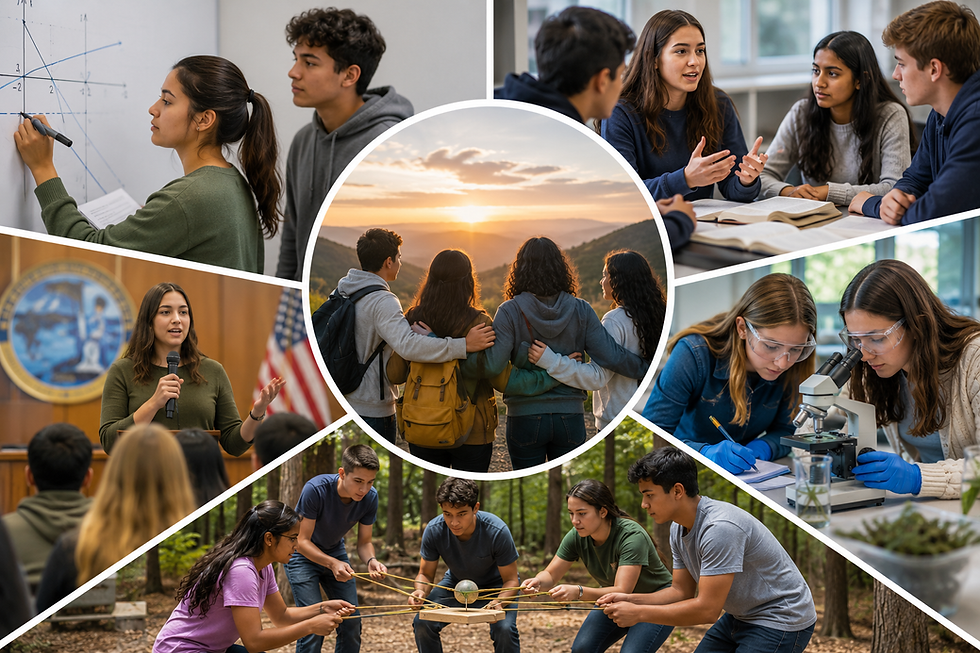
Imagine a classroom where students aren't just learning mathematics—they're collaborating to solve a real-world problem. They're not simply analyzing literature—they're discussing difficult perspectives, defending their ideas with evidence, and learning to respectfully disagree. They're not only studying government—they're identifying a challenge in their own community and developing solutions. They're not just completing a science lab—they're working as a team to investigate, test, adapt, and present their findings.
These are the experiences students remember.
More importantly, these are the experiences that shape who they become.
Research consistently shows that meaningful, hands-on learning experiences help students develop far more than academic knowledge. Students build confidence, resilience, communication skills, collaboration, leadership, and a stronger belief in their own abilities.
One of the strongest predictors of future success is self-efficacy—a person's belief that they can accomplish difficult tasks and overcome challenges. A 2021 meta-analysis involving more than 2,600 adolescents found that experiential learning programs significantly improved students' self-efficacy. Students didn't become more confident because someone told them they could succeed. They became more confident because they experienced success while working through authentic challenges.
Researchers have found similar results when examining leadership development. A 2023 systematic review reported consistent improvements in leadership, communication, teamwork, initiative, decision-making, responsibility, planning, and self-confidence among students participating in experiential learning programs. These skills developed because students were asked to solve problems, make decisions, collaborate with others, and reflect on what they learned—not simply memorize information.
The research confirms something many educators already know:
Students grow when they are given opportunities to think, struggle, collaborate, reflect, and succeed.
What Could This Look Like in Your
Classroom?
Experiential learning doesn't require rewriting your curriculum or sacrificing academic standards. In fact, some of the most meaningful learning experiences happen while teaching the very content you're already expected to cover.
Imagine students applying algebraic concepts to calculate the cost of restoring a local habitat, comparing water usage, or designing the most cost-effective solution to a community challenge. Suddenly, mathematics becomes more than numbers on a page—it becomes a tool for solving real problems.
In English Language Arts, students might participate in a structured Civil Dialogue after reading a novel or informational text. Rather than simply answering comprehension questions, they learn to support their ideas with evidence, listen respectfully to differing perspectives, and engage in thoughtful, productive conversations.
Science classes can move beyond the textbook as students investigate local ecosystems, study pollinators, analyze food webs, examine wetlands, or explore adaptations through live Birds of Prey experiences. Students ask questions, collect evidence, think like scientists, and connect classroom concepts to the world around them.
History and government classes can bring civic learning to life by guiding students through authentic community projects aligned with the California State Seal of Civic Engagement. Students identify local issues, research possible solutions, collaborate with community partners, and discover how they can make a positive impact.
Even a simple team-building challenge can become a powerful lesson in communication, perseverance, leadership, and problem-solving when students are given time to reflect on their experience and connect it back to the skills they'll use throughout their lives.
These experiences don't replace academic learning—they deepen it. Students continue mastering standards while simultaneously developing the confidence, communication, collaboration, critical thinking, and leadership skills that will serve them throughout their lives.
The Difference Is Reflection
An experience alone doesn't guarantee learning.
A science lab, a classroom debate, a service-learning project, or a team-building challenge can simply become another activity unless students have the opportunity to reflect on what happened.
Reflection is where transformation begins.
Questions like What worked?, What challenged you?, How did your team respond?, What would you do differently next time?, and How does this connect to our learning? help students move beyond completing an assignment to understanding themselves as learners, teammates, and leaders.
This intentional cycle of experience, reflection, and application transforms an activity into meaningful learning.
How Discovery Leadership Institute Can Help
At Discovery Leadership Institute, we help educators transform everyday lessons into meaningful learning experiences. Through standards-aligned curriculum, professional development, classroom resources, and hands-on programs, we make it easy to integrate leadership, civic engagement, and experiential learning into any classroom.
Whether you're looking to enrich a single lesson or build a schoolwide culture of engagement, we're here to provide practical tools, proven strategies, and authentic experiences that help students grow in confidence, character, and leadership—while meeting your academic goals.
Because years from now, students may not remember every worksheet they completed or every lecture they heard.
But they will remember the challenge they overcame.
The project they led.
The problem they solved.
The discussion that changed their perspective.
The moment they realized they were capable of more than they ever imagined.
Those are the experiences that shape confident learners.
Those are the experiences that develop leaders.
And those are the experiences that change lives and possibly shape who they become.


Comments